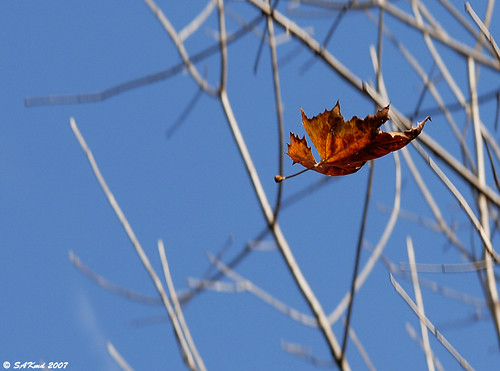
Sunday, May 12, 2013

Nature, by Henry Wadsworth Longfellow


As a fond mother, when the day is o’er,
Leads by the hand her little child to bed,
Half willing, half reluctant to be led,
And leave his broken playthings on the floor,
Still gazing at them through the open door,
Nor wholly reassured and comforted
By promises of others in their stead,
Which, though more splendid, may not please him more;
So nature deals with us, and takes away
Our playthings one by one, and by the hand
Leads us to rest so gently, that we go
Scarce knowing if we wish to go or stay,
Being too full of sleep to understand
How far the unknown transcends the what we know.


Monday, February 25, 2013

The Donkey’s Foot Is Sure Along the Path


"Jesus, Mary and Joseph!" 
No prayer - yet. 

There will be many days and nights to offer prayer.  
No, no prayer.  A shout of anger and frustration 
Barked up to an indifferent world.
Shame and fear, a calmer voice,
“Is there a chance they could have made a misdiagnosis?” 
None and now, 
Blood, 
Chaotic and lost, turns on itself 
And consumes the host.

Jesus, Mary and Joseph.
Jesus Sweet Christ.  
Where is that muscular savior, 
That laughing God son?  
He has gone to the field with his disciples and 
I can see him at the crest of the hill, 
Boldly swinging his scythe.  
Bless this harvest.

Jesus, Mary and Joseph.  
Where is that rustling warmth?
Where are the delicate hands
Running through my hair, 
Drawing my throbbing head to rest
On the breasts that fed a child God?  
Jesus, Mary and Joseph.  
There she sits in high crowned glory,
Robed in the sky, 
Her eyes glittering and indifferent.

Jesus, Mary and Joseph.  
So here we are 
Left with little Joseph.  
Patient as bees, 
Slowly he  draws the blade 
Along the beam edge 
To erase the last imperfection.  
He hears the crowd outside 
Swept along its way to Jerusalem and
He returns to his tools. 

Jesus, Mary and Joseph.
Joseph leads the donkey along the path, 
Unburdened now – no mother, no king.  
And I follow.

The donkey’s foot is sure along the path 
But so close to the cliff edge 
I can hear breezes lift
With the heat to move my hair.  
They whisper how easily the sparrows rise 
On their wings, how easy is the flight 
Across the river.  But if I gaze over the edge 
The rocky bed is very far below 
And the water is black with the dead. 

Friday, September 14, 2012

Touch Me by Stanley Kunitz


Summer is late, my heart.
Words plucked out of the air
some forty years ago
when I was wild with love
and torn almost in two
scatter like leaves this night
of whistling wind and rain.
It is my heart that's late,
it is my song that's flown.
Outdoors all afternoon
under a gunmetal sky
staking my garden down,
I kneeled to the crickets trilling
underfoot as if about
to burst from their crusty shells;
and like a child again
marveled to hear so clear
and brave a music pour
from such a small machine.
What makes the engine go?
Desire, desire, desire.
The longing for the dance
stirs in the buried life.
One season only,
and it's done.
So let the battered old willow
thrash against the windowpanes
and the house timbers creak.
Darling, do you remember
the man you married? Touch me,
remind me who I am.


There is a very good article on Kunitz at http://www.theatlantic.com/magazine/archive/1996/06/a-visionary-poet-at-ninety/304941/2/.  There are also several videos on YouTube of the author reading his work.  I took the photo the accompanies this post.

Wednesday, August 29, 2012

WHEN MAN ENTERS WOMAN by Anne Sexton


Any man quoting a poem by Anne Sexton is probably on shaky ground.  You think you know what she is talking about, but there is an uneasy feeling that you are missing the point entirely and it only remains for some woman to point that out to you.  That being said, I still feel that Sexton speaks to me from time to time.  She once wrote "This loneliness is just an exile from God."  My entire personal theology could be summed up in that one line (the key? 'only').  So I am going to give this a go.  I think I have her point in this poem.   If not, there is a legion ready to correct me.  This poem is from The Awful Rowing Toward God (1975), a book that was a gift and a curse and has haunted me for decades.

When man
enters woman,
like the surf biting the shore,
again and again,
and the woman opens her mouth in pleasure
and her teeth gleam
like the alphabet,
Logos appears milking a star,
and the man
inside of woman
ties a knot
so that they will
never again be separate
and the woman 
climbs into a flower
and swallows its stem
and Logos appears
and unleashes their rivers.

This man,
this woman
with their double hunger,
have tried to reach through
the curtain of God
and briefly they have,
though God
in His perversity
unties the knot.


Image Source

Wednesday, July 18, 2012

Still Joy To Be Found


There is still joy to be found.
Pleasure in the optimism of birdsong,
Relentless waves against the beach,
The absurdity of flying beetles.

Those obnoxious, brilliant orbs,
Their color a distillation of every green,
Seem better suited for clinging
To the edge of delicate blossoms
Or moving tank-like through the grass.
But then those iridescent shells
Burst forth wings. What joy!
They take flight across the lawn,
Mad to find the next flower.

When I go, as I one day will,
Do not lay me out on white satin.
Don't paint my face to give it life.
Do not fill the coffin's edges with
bottles of liquor or pens or books;
Talismans of a life.

Burn me down and put my ashes
In a box of iridescent green,
the color of a beetle's shell.

I'll spread my own absurd wings.

Sunday, July 1, 2012

This is not for you, now


I watch her check her mail 
while she waits for her salad in the pub. 
She'll pack it up and take it back to her room. 
She can relax then and let go a bit, 
kick off her espadrilles, 
the ones she had hand made in Spain 
by Lika Mamika.
Maybe she'll wait until later to open her laptop.

The afternoon light glints off the Neponset 
and reflects in her half rims. 
The thick page boy colored to match 
her russet blouse and matching capri's.
Not bad for her age, as they say. 
My age. 
Good hands, thick gold rings. 
Married well with a good job besides? 
Somebody in charge, a decision maker.

I am sure her garden is bright with flowers. 
Well ordered, controled , always in balance.
She is ruthless with the plants 
that do not bend to her command. 
Beneath her wide-brimmed sea grass hat,
her eyes search the ground for the errant plant. 
The trowel plunges into the earth again and again. 

At dusk she comes into the kitchen, 
lays her gloves on the black marble counter,
turns on the faucet and runs her hands under the stream, 
her rings glinting in the sunlight. 
" A good day's work" she says to her husband.

He struggles to remember the curve 
where flower meets 
curve of inner thigh. 
He says nothing, 
but silently roots for the weeds.  

Quincy Ma, 
June 19, 2012


Friday, May 25, 2012

Deer Bones

I wrote this poem this week after listening to Gary Snyder reading from his poems at the Library of Congress in 1966.  The 'facts' of the poem are true, but not contiguous in time.  I wanted to write a concrete poem about an incident that happened a few years ago when I had literally stumbled on a deer skeleton after stepping into the bushes to pee.  When I got home and began to write, the older story of being left on the side of the road just snuck into the poem and the theme began to emerge. It is true that I have always been teased about my small bladder, but as I have gotten older it just seems to be more acute.  Hence the theme of growing old and ending up, ultimately like the deer.

Deer Bones


I drive home in the rain from the train station, a point along the way 
Car to train to subway to office building and back again.
The beer I had in the club car cries for release and 
I finally can put it off no longer.
I pull over at wide spot beside a stone wall and slip into the woods.
I step in a bit and piss into the wet leaves, steaming in the drizzle.
God, I hate growing old, with a bladder 
The exact capacity of a twelve ounce beer.
Curse my age. . . . but only a little.  
There is relief in standing amid the dripping trees
Beside the empty road beyond the undergrowth – a bit naked and free at least.


And it is not as though my need to pee is really
All that new . . . night on a lonely road in Connecticut
Three of us standing in the tail light’s red glow,
Piss splashing off the warm asphalt.
We were young or drunk or possibly both.
They drove away without me because I was too slow or the butt of some joke.
I watched the tail lights round the curve into the black forest and was left
Standing on the empty road.
The sound of frogs in ditch water and a breeze crossing the grassy fields,
Undulating in the darkness,   I am sure I laughed with joy.
They came back, of course and we all laughed
And probably drank some more.


Now I finish up with the wet air cold on my face and turn to go.
That’s when I see the bones heaped under the pine.
I first see the cage of ribs and then long thigh bones;
Coming closer, the skull and antlers, the bare grin of teeth.
I am no huntsman so I can’t tell if this deer staggered
off the road  with a shattered pelvis to die panting under this tree.
Or was he blinded in his majesty by a flashlight and a sharp report?
One shot echoing in the night, then another for good measure.
Was he hastily butchered  - the hindquarters and shoulders
Skinned and sliced away, the rest left to throw wardens off the trail?
I can’t tell.  For all I know this deer died a natural death;
Died of starvation;
Died of old age;
Died of love.
How the hell should I know?


I run my hands lightly along the smooth antlers, 
As yet unchewed by porcupine, squirrel, rabbit, mouse.
I am tempted to take some souvenir  but think the better of it.
I chose to honor this open grave, this white memorial to change;
To coming and going, to life and death, to wide eyes and
Twitching nose and strong legs and flashing tail;
Honor this white monument of pure smooth bones.
Well, that’s what I tell myself anyway, as I zip up and
Make my way through the waning light
Back to the car,
And the drive home. 


05/22/2012

Ok, so this site has nothing to do with my poem, but I was looking for images and found this one

You have to check out this very cool site of images of the Goddess .  http://www.pbase.com/stephen_collector/the_goddess&page=4


Tuesday, May 1, 2012

Time Does Not Bring Relief by Edna St. Vincent Millay


Time does not bring relief; you all have lied
Who told me time would ease me of my pain!
I miss him in the weeping of the rain;
I want him at the shrinking of the tide;
The old snows melt from every mountain-side,
And last year's leaves are smoke in every lane;
But last year's bitter loving must remain
Heaped on my heart, and my old thoughts abide!
There are a hundred places where I fear
To go - so with his memory they brim!
And entering with relief some quiet place
Where never fell his foot or shone his face
I say "There is no memory of him there!"
And so stand stricken, so remembering him! 


image source

Tuesday, April 24, 2012

Passengers by Billy Collins


Traveling to Chicago this week, this poem concerning flying struck me.  I am sure Breanne knows what I mean, although I am sure she doesn't feel like jubilizing . . . . .

At the gate, I sit in a row of blue seats
with the possible company of my death,
this sprawling miscellany of people---
carry-on bags and paperbacks---

that could be gathered in a flash
into a band of pilgrims on the last open road.
Not that I think
if our plane crumpled into a mountain

we would all ascend together,
holding hands like a ring of sky divers,
into a sudden gasp of brightness,
or that there would be some common spot

for us to reunite to jubilize the moment,
some spaceless, pillarless Greece
where we could, at the count of three,
toss our ashes into the sunny air.

It's just that the way that man has his briefcase
so carefully arranged,
the way that girl is cooling her tea,
and the flow of the comb that woman

passes through her daughter's hair . . . 
and when you consider the altitude,
the secret parts of the engines,
and all the hard water and the deep canyons below . . . .

well, I think it would be good if one of us
maybe stood up and said a few words,
or, so as not to involve the police,
at least quietly wrote something down.


Saturday, April 14, 2012

Roots: Epigrams

Image Source
These epigrams are pretty good pointers to the influences and reading I did in the past that led me to write and be a thinking person.  Sorry I don't have more specific references, other than the book titles.

"To write poetry means to exist in that joy which preserves in words the mystery of proximity to the Most Joyous.  Joy is the joy of the poet."
"Remembrances of the Poet", Martin Heidegger 

"The Chinese poet relates that men did not want to hear the song that he was playing on his flute of jade; then he played it to the gods, and they inclined their ears; and ever since, men, too have listened to the song . . . "  And thus he went from the gods to those whom the image cannot dispense.
I and Thou , Martin Buber

" . . . a dance always imitates an archetypal gesture or commemorates a mythical moment.  In a word, it is a representation, and consequently a reactualization, of illud tempus, 'those days'."
Myth of the Eternal Return, Mircea Eliade
"Immature poets imitate, mature poets steal; bad poets deface what they take, and good poets make it into something better, or at least something different."
T.S. Eliot

 "Ignorant people use the most idiotic words sometimes with a dignity, a force of feeling that makes them glow and flare.  I listen in profound silence . . . later I try to imitate. I almost always fail."
William Carlos Williams
I am soft sift
In the hourglass - at the wall
Fast, but mined with a motion, a drift,
  And it crowds and it combs to the fall;
I steady as a water in a well, to a poise, to a pane
But roped with, always, all the way down from the tall
  Fells or flanks of the voel, a vein
Of the gospel proffer, a pressure, a principle, Christ's gift.
"The Wreck of the Deutschland", Gerard Manley Hopkins
He drew forth a phrase from his treasure and spoke it softly to himself:
-- A day of dappled seaborne clouds --
The phrase and the day and the scene harmonized in a chord.  Words.  Was it their colours?  He allowed them to glow and fade, hue after hue; sunrise gold, the russet and green of apple orchards, azure of waves, the greyfringed fleece of clouds.  No, it was not their colours; it was the poise and balance of the period itself.  Did he then love the rhythmic rise and fall of words better than their associations of legend and colour?  Or was it that, being as weak of sight as he was shy of mind, he drew less pleasure form the reflection of the glowing sensible world through the prism of a language manycoloured and richly storied than from the contemplation of an inner world of individual emotions mirrored perfectly in a lucid supple periodic prose?
Portrait of the Artist as a Yong Man, James Joyce

" . . .On the other hand there is Flossie, my wife, who is the rock on which I have built.  But as far as my wish is concerned, I could not be satisfied by five hundred women.  As I said at the beginning, I was always an innocent child . . . Men have given direction to my life and women have always supplied the energy."
William Carlos Williams

Saturday, April 7, 2012

Talking with Lover

These poems were written after meeting Dawn's grandmother who the family called Lover.  She was colorful, to say the least.  She lived to attend our marriage, but these poems were written after that , probably in the early 1980' and , based on a night of conversation with her at her apartment in Southhampton.  I distinctly remember coming into her apartment in the middle afternoon and her first suggestion was that I 'make myself a highball', totally baffling to a recent college grad in the '80s.  I found her charming and hilarious, as I did my own grandmother, but I heard that she was a force of nature in her day.  As a child, she was bilingual in German and had visited her family in Northern German with her mother.  Her father worked at the Arion Club in New York and they lived in apartment there for a time. I tried to capture her voice and cadence in these poems.

i
I remember very clearly,
very clearly,
the kitchen, lace curtains and
the little garden
outside the door and the long window

like this, you see.

They had a bowl of cherries on the table
- always adults around me then - and
they told me not to eat anymore.
But when they left,
I did,
pits and all.

Yes, that must have been in
nineteen and four

or five.

ii
This is my father.
(The proud
moustachoed
German,
stout as a puppy,
on his horse in Central Park.)

He died of heart failure
at the age of thirty.
Mother believed it was
because of the five flights he had to walk up
to where we lived above the Arion Club.
When Mother told me - I was six -, I said
"Aber Mutter, musst du wieder trauen."

I accepted it.

iii
(She glows like sixty years ago,
dusky hair in a thick braid next to
her dark eyes and girlish smile.)

We walked arm in arm along the beach
but the next day her brother came and told us
that she had died.  Of polio, the night before.
Her mother never recovered from her grief.

We had walked arm in arm - that day!

So you see, there have been sorrows
like your own

great sorrows.


Sunday, March 18, 2012

Sonnet 29 by William Shakespeare


This sonnet is dedicated to  my long suffering and supportive wife, Dawn. She continues to support me as I struggle to find any sort of enjoyment or satisfaction with my job.  I know it must be hard to hear me in such despair about how my work is going, but she always has words of wisdom and love and helps me carry on.


When, in disgrace with Fortune and men's eyes,
I all alone beweep my outcast state,
And trouble deaf heaven with my bootless cries,
And look upon myself and curse my fate,
Wishing me like to one more rich in hope,
Featured like him, like him with friends possessed,
Desiring this man's art, and that man's scope,
With what I most enjoy contented least;
Yet in these thoughts myself almost despising,
Haply I think on thee, and then my state,
Like to the lark at break of day arising
From sullen earth, sings hymns at heaven's gate;
   For thy sweet love rememb'red such wealth brings,
   That then I scorn to change my state with kings.


Image Credit

Thursday, February 23, 2012

On Turning Ten by Billy Collins

I have been reading Sailing Alone Around the Room by Billy Collins, the Poet Laureate.  I am not taking a lot away from the book so far.  He certainly can write, but I don't feel moved by most of his poems.  Sometimes, however, I need to re-read them a couple of times.  One however, struck me immediately.  I was reminded of some conversations I have had recently with Emica about her childhood and  in thinking about my own. It is the fourth stanza that resonated with me in this poem.


On Turning Ten


The whole idea of it makes me feel
like I'm coming down with something, 
something worse than any stomach ache
or the headaches I get from reading in bad light - 
a kind of measles of the spirit,
a mumps of the psyche,
a disfiguring chicken pox of  the soul.


You tell me it is too early to be looking back,
but that is because you have forgotten
the perfect simplicity of being one
and the beautiful complexity introduced by two.
But I can lie on my bed and remember every digit.
At four I was an Arabian wizard.
I could make myself invisible
by drinking a glass of milk a certain way.
At seven I was a soldier, at nine a prince.


But now I am mostly at the window
watching the late afternoon light.
Back then it never fell so solemnly
against the side of my tree house,
and my bicycle never leaned against the garage
as it does today,
all the dark blue speed drained out of it.


This is the beginning of sadness, I say to myself,
as I walk through the universe in my sneakers.
It is time to say good-bye to my imaginary friends,
time to turn the first big number.


It seems only yesterday I used to believe
there was nothing under my skin but light.
If you cut me I would shine.
But now when I fall upon the sidewalks of life,
I skin my knees, I bleed.


Thursday, November 17, 2011

Look, Stranger at this Island Now by W.H. Auden

Reading this poem last night in bed, I was on the verge of tears.  Why, I wonder?  Is the clue in the poem or in the reader's mind?  I must have read it a dozen times.  I still wonder.

Look, stranger, at this island now
The leaping light for your delight discovers,
Stand stable here
And silent be,
That through the channels of the ear
May wander like a river
The swaying sound of the sea.


Here at the small field's ending pause
Where the chalk wall falls to the foam, and its tall ledges
Oppose the pluck
And knock of the tide,
and the shingle scrambles after the suck-
ing surf, and the gull lodges
A moment on its sheer side.


Far off like floating seeds the ships
Diverge on urgent voluntary errands;
And the full view
Indeed may enter
And move in memory as now these clouds do,
that pass the harbour mirror
and all the summer through the water saunter.
                                                                        November 1935


Friday, October 28, 2011

A Refusal to Mourn

It is October and traditionally as the days grow crisper,  I exchange my gin for scotch (or Canadian whiskey).  It is the time when I dig out my broken-backed copy of the Dylan Thomas' Collected Poems.  The two are inter-related, of course.  Thomas is meant to be read out loud with the book in one hand and a drink in the other.  The birthday poems, "Poem in October" or "poem on his birthday' are my favorites and I have quoted them before in this blog. To be shouted to the heavens in defiance! Yes!

But today's poem is a good closure in my mind to the last few posts on Morgan.  You can read a poem over and over again and then, one day, it finally clicks and you understand exactly what the poet meant.  Why?  Is it that the puzzle of the words is solved? Or is because of the experiences you bring to a poem unlock its secrets?  Is the poem an empty vessel for our emotional experiences, or a source and repository of images and ciphers that explain and illuminate?

A refusal to mourn the death, by fire, of a child in London
Never until the mankind making
Bird beast and flower
Father and all humbling darkness
Tells with silence the last light breaking
And the still hour
Is come of the sea tumbling in harness

And I must enter again the round
Zion of the water bead
And the synagogue of the ear of corn
Shall I pray the shadow of a sound
Or sow my salt seed
In the least valley of sackcloth to mourn

The majesty and burning of the child's death.
I shall not murder
The mankind of her going with a grave truth
Nor blaspheme down the stations of the breath
With any further
Elegy of innocence and youth.

Deep with the first dead lies London's daughter,
Robed in the long friends,
The grains beyond age, the dark veins of her mother,
Secret by the unmourning water
of the riding Thames.
After the first death, there is no other.


Image Source

Thursday, October 20, 2011

Last Day of Indian Summer


Monday October 22, 1979
Dearest Child,
It is 12:50 now and we know that you have died in the womb.  Why or how, we cannot say.

Where was God?
dancing in your heart
my little unborn babe,
my little wave.

Now Dawn and I must birth your dead body out.  This is a testing time for us, and would have been for you as well, but you are dead.
Such a simple thing - death.  For one like yourself, warm and hidden in Dawn's womb I am sure it was an easy death, a happy death.  But Dead you are, and we . . . we must bear the pain.

1/3/80
Morgan

Tonight I found your picture
neatly folded, hidden in my wallet.
I remember that light filled Summer day
alive with the sound of crickets in the new-mown hay.
In the cool darkness of the hospital room they 
attached the equipment to Dawn's belly and 
opened a window on your place.
We watched you wriggle your toes with 
the careless abandon of a child.
Tiny elfling in your mama's belly
floating, gurgling in an amniotic world.
(The picture shows you smiling, I swear,
through your fluid playground.)
Strange isn't it? In a single moment I
saw your birth, your first steps, splashing baths,
fearful first days of school, dates, love, education,
beauty, work - in your wiggling toes I witnessed
the entirety of your existence.

II

The night before you died
Dawn and I lay like spoons
and I felt your nudging insistence
against my arm as I enfolded you both.
You still strove toward the light
toward freedom from your fluid world.
(Hadn't you listened to your mother
weeping in the darkness, whispering for you
to stay inside . . . where love was as real
as the blood that passed between you?)

III

As you crouched dying , slipping away
in silence, aware only of your mother's heartbeat
quietly booming in your ears,
What did you recall?
Did you hear again my muffled voice
call to you through Dawn's belly?
Purring cats kneading their paws against you?
Car rides with the sound of laughing friends?
The pull of the tide on your fluid world
when Dawn and I walked beside the sea?
In the brief span of your life
what treasures lay in the halls of your mind?
What primal impulses quicken your breast?
What did you dream as you crouched, dying?

IV

In the warm fluid darkness of the womb
what is death like?
How differs the fetal sleep from that of the dead?
Did you die in your sleep as we lay sleeping?
Death knows only questions - never answers, never answers.

When you were born you were as warm as life.
You lacked nothing save a little breath,
save God's anointing spirit.
Was death easy for you?  Letting go so painless?
I wondered how long your spirit lingered.
Did you stay by to ease our pain?

V


I recall when I was very young my
grandmother bathing me, choosing clothes
for me to wear, laying me on the kitchen
table of the farm house which haunts my dreams 
even now.
My Grandmother, my Nana, 
who herself once bore a girlchild with dark hair 
and round cheeks like your own.

Into her hands I commend your infant spirit
for safe keeping until I myself can come 
to you and hold you 
again
to my heart.


Sunday, October 2, 2011

The Final Grains Run Down


                                                            October 10, '79
Dear Boy-Child
Today Dawn and I began to try to find a name for you.  So far we have yet to come together on anything. so you remain the "wee baabie". But know that we are working hard.
Yesterday we calculated that you had come full term. Now it is up to you to leap out of the womb.  Surely that must be a frightening thing, but it will be the first strong act of your life and we are all here struggling to catch you as we ourselves fall (that is a pun on Heidegger which I hope you will one day understand, if not today).
Dawn and I are very happy now, much more than when you were conceived.  Those were dark times, times of desperate running, of searching for the love promised before in August.  I think now we have learned to find a balance between space and together, or at least we are more sensitive, more tolerant of the other's ways.
But all of this you know, you eavesdropper on our every conversation.  More, you know the silent thoughts of your mother that even I do not.  If you are indeed a boy-child I hope you always keep that bond for I have and it is a good thing. Speaking of bonds, this too you must know, in my mother's family, from her mother and her mother's mother has come the gift - reading cards, premonitions, "seeing".  I feel a sense of it in myself. Perhaps you too will share in this family gift.  The stars are right for it.
(I wish I could explain the Heidegger reference today.)  I do remember my Nana telling fortunes with ordinary playing cards.  My mother has always been interested in astrology and I have been interested in the Tarot and its relationship to the unconscious.     
Nothing prepared me, however, for the changes about to happen; changes what would effect my life to this day.  For now, let's just leave the image I had when I wrote this, of a brave little child  preparing to face the world.  Unimagined, time was slowly ticking away and the hourglass was nearly empty.


Thursday, September 22, 2011

My Dearest Son

Sunday, September 16, 1979
My Dearest Child,
On the opposite page, I have taped a picture of myself taken not long after you were conceived.  You will have seen many pictures of Dawn and I by now, but I think this is by far the best likeness of me I have ever had taken, so I include it here. I wore glasses then, too, but as I often took them off to do important work - write, read, talk, so I didn't include them here.
 We all have a mental picture of ourselves, no matter what our actual age.  Our own mental image - who we expect to see in the mirrored surface of a window as we walk down the street.  This picture represents how I imagined myself for years.  I would have been 21 at the time, I think.

Thursday, Sept. 28
My Dearest Son, if that be so,
Today I am frantically working to find you a name.  In less than two weeks, I am told, you will be born.  Are you feeling confined in the womb that has nurtured you for so long? This, my baby, is not the last of these wombs, from which you must birth out.
As to your name  - I am trying to find a name that will convey all the hopes and dreams I have of and for you, yet still give you the freedom to be who you want to be.  Right now I am taken by the name Deror - it is Hebrew for freedom, or free flowing.  Freedom is the most important thing or state of mind we can have and my hope is that freedom will always be paramount among your concerns.
Besides, having a name like Deror will set you apart, your name will have a magic which none of your peers can take from you.  this being apart is a good thing, I think.  It is in this loneliness that creative ability and art comes.
I hope that is not to heavy a burden for you to carry - such a name and such a setting apart.  I think it will be a good one - for we all carry burdens, the rocks we push up hills only to see them fall again and again.  Let us at least be happy in the struggle.  You know that I love you and apropos that is a quote from Rilke:
"All we can offer where we love is this: to love each other; for to hold each other comes easy to us and requires no learning."
                                                                         Requiem
But for now, my love must be nurturing and holding.  And preparing.
The first thing that surprises me is that two weeks before she was due, we did not know Morgan's gender.  How innocent compared to the other pregnancies, miscarriages and births, that we should know so little about what was going on in the womb.  We did have a sonogram, but it apparently showed nothing conclusive.  We still have it, in the fireproof box of course, with the birth certificates and other important papers.  Sometimes I wonder what it would have been like . . . to have a son instead of daughters.  Would I have been a better father, or worse?  A better man?  What would have been my expectation for my son?  It seems like I was already freighting his life with my expectations.  What if he had grown up to be a jock?  or a stock broker?  This short journal is a treasure of what ifs and the gender of my children is certainly an interesting hypothetical topic;  as it was, three for three.  I can only hope that if Morgan, Emica or Breanne had been a boy that I would have striven to give him the same nurture and caring; the same generosity and discipline; the same love, in other words, that I have tried to give to my daughters. . .  and received in return.


Monday, September 19, 2011

A Bourgeois Beginning

Recently I discovered some pages from a journal I intended to keep for my first child.  On the one hand, knowing now what was to come, they seem sad.  But on the other hand, they are an honest reflection of what I was feeling those last heady weeks before Morgan was born.  And, perhaps, there is message for my other daughters. . . or not.  Who knows.


September 7, 1979

My Dear Child,
I am endeavoring to keep this journal for you, that someday you may read it and experience your youth from my perspective as your father.  As much of our childhood as is retained (albeit in our unconscious, very often) just as much is lost from us.  Of my own past I know not as much as I would like.  About my parents, your Grandparents, there are mysteries only hinted at and never made clear to me.
But this is a book for you, not necessarily for me, yet I must begin with our past - yours and mine.  Our name is French and in the form BOUTILLIER was granted to our family in 1593, in Lorraine.  Tradition has it that our family were Huguenots - French Protestants and were expelled from France for that belief. However, another story claims we were given land in New France for helping Napoleon, the latter is rather suspect, as Canada was controlled by Great Britain at the time.  In any case, the family settled in the St. John valley and adjacent Aroostook county - as did the Bakers and Lovelys, your Grandmother's family.
The significance of all this lies in our bourgeois background.  Huguenots were traders and merchants - entrepreneurs who built and strengthened the capitalist system.  There lie our roots in a revolutionary class and we must be proud of that.  We are and always have been of the middle class and can do not otherwise, I fear.  

What makes me sad about this passage is the comment about not knowing, or better - remembering, my own past.  This is true.  It is amazing to me when I get with my sisters and they remember so much about our growing up. . . . I remember very little.  What amuses me is the statement about being of a 'revolutionary class'.  I was being very specific concerning that reference and it demonstrates, I think, an understanding of the role of classes in history beyond the typical characterization of 'bourgeois' as stupid or boring, or anti-revolutionary.  However, it may also have been a recognition that we are what we are and that I was always going to be the middle class son of middle class parents.  We were not going to ever be proletarian, working class in the revolutionary sense that the bourgeois were revolutionary in contrast to feudalism.  But then again, neither was Lenin or Marx.

And now the rallying cry is not "Workers of the World Unite", it is "Save the Middle Class".  What we took for granted 30 years ago seems like a dream today; that an education and hard work could create a secure world to live in.  At the time, I assumed we had a choice which side of history we would fall on, I am not so sure my children feel that freedom to chose between being middle class and working class.  One small step, one missed payment, one lay off and they are in danger of tumbling down into the pit from which it takes generations to claw your way out of.

Image Credit

Friday, September 2, 2011

When a French Name is Not French.

After doing some antiquing in Boutiliers Point, we were on our way West along the southern coast of Nova Scotia.  The weather turned very rainy that day and we weren't stopping long anywhere.  One of the locations Dawn wanted to visit was Lunenburg, since her family is German and we thought the weather might clear and give us a chance to walk around this UNESCO World Historic site.  No such luck.  It was pouring rain when we arrived and we were both too discouraged to get out.  However, this town with its historic downtown and waterfront (which we drove through) and Bluenose Schooner make this place at the top of our list of places to visit on our next trip to NS (and oh, yes, we definitely want to come back.)  On our way out of town, however, we stopped at the tourist center and made this discovery, the Monument to settlers from Montebelaird.  The original Boutiliers, came from this French speaking, but independent, Protestant principality along the French/Swiss border in 1752, at the invitation of the British government.  They were part of a group of German, Swiss and Montebelairdian settlers meant to act as a counterbalance to the Acadian population in Nova Scotia.  The Acadians, celebrated in Longfellow's poem Evangeline,were descendants of the original French settlers.    As such, their loyalty was often in question in British eyes.  The French in the early part of the 18th century still controlled a significant part of the Maritimes from their fortress in Louisburg.  Although the Acadians requested that they play a neutral role in the British-controlled Nova Scotia, eventually, in conjunction with the French and Indian War, as it is known in US History,they were deported from the province in what was known as the Great Expulsion. This photo is of a monument on the waterfront in Halifax that shows the forced migrations of the Acadians.


In 1752, Bouteillers (Boutiliers) arrived from Montebelaird region to settle in Lunenburg and surrounding areas.  They were meant to replace the Acadians and support the British Crown. Hence, in my opinion, the reduced importance of speaking French in the family.  I knew of no relative in our family that spoke French, going back to my great grand parents.  The strong ties that bind French Canadians - language, history, and Catholicism have always been missing from our family heritage.  Now I better understand why. These were folk who were looking to adopt the language and customs of their new Mother country - Britain.  There would have been no harkening back to the good old days in France or Montebelaird.  They would not have been leaving their homeland to extend their country via her colonies but to create a new life in a new land, to create a nation that would become Canada.


So at least now, I have a place to start and a confirmation that our family came to Nova Scotia, not from France (although Montebelaird would be incorporated in 1793 into France), but from an independent nation. And that they were, as always maintained, huguenots- French Protestants.  Now to start making the connections between those settlers and the family branch that wandered into Aroostook County, Maine and became my ancestors.

Sunday, August 28, 2011

What's in Name Part Two

In my last post, we were on our way to Boutiliers Point in Nova Scotia.  When we arrived, the first stop was the St. James Anglican Church graveyard.
It was kind of creepy, as Dawn pointed out, that the graveyard was virtually filled with Boutiliers.  There were monuments to veterans and victims of the Halifax Explosion of 1917. One of the most moving and mysterious was this one that listed an entire family of various ages.

Of course, it would only be a matter of time until . . . .
The freakish thing, of course, was he died just a year after I was born.
Here are a couple more views of the outside of the church (that is Dawn in the foreground) and what we took to be the Point opposite the church.


In my next post, I will reveal the truth about why we don't speak French anymore in our family.

Sunday, August 14, 2011

What's in a Name

Boy, I didn't realize what a hiatus I had taken from this blog until I opened up today! Almost two months of no postings is not good! However, we have just returned from our Summer vacation and I am full of enthusiasm for doing the things I enjoy like this blog. For our vacation this year, we spent two weeks touring Nova Scotia.  In part we went because we haven't been there and I was particularly interested since my family originally came to the Americas from there. With some superb hasty coordination from Dawn, we were able to get to Moncton NB in one day and be on the peninsula of Nova Scotia the next.  We drove around about two thirds of the perimeter of the province, including Cape Breton Island, in a clockwise rotation.  Most of the time we had good weather, with a few spectacular days, a few very rainy days and most days very good. We had considered camping, but decided at the last minute to leave early and Breanne and Evan had the equipment so we stayed in a combination of settings from a hotel one night, hostels, two college dormitories and the remainder of the stay in B&Bs.

As I said, I was interested in finding my family roots.  I knew there was a Boutilier's Point northwest of Halifax, but was surprised when our drive took us past a location called Boutiliers Cove as well.
In the nearby graveyard attached to the Anglican church, we began our search for relatives.  I do not know of any specific names to look for, but we found several Boutiliers in the graveyard, often the graves of infants or children.  One of the oldest stones in the yard also gave us an important clue to look for.
This stone was interesting on two counts, the alternative spelling of LeBoutillier and the fact that Susan was married to the son of Loyalist parents.  I knew from family tradition that Boutiliers were Huguenot, that is French Protestants, and that this spelling had been used in the past.  There has also been a tradition of Loyalists in the family (those who remained loyal to the British Crown during the American War of Independence).  If the family arrived in Nova Scotia in the 1750s or 1760's as tradition always had it, Susan would most likely have been a daughter or perhaps granddaughter of an original Boutilier settler, having been born in 1784.

Another interesting stone related a twin tragedy of a brother an sister, both of whom died at age 19.  the young man in on the battlefields of France in 1918.

We got back on the road again toward Boutilier's Point, but before arriving, I noticed a monument in front of a Royal Canadian Legion Hall. It confirmed that Robert was not the only Boutilier to have died in World War I and II from the area.

Eventually, we reached Boutilier's Point, where a few surprises awaited us. I will relate them in my next post.  Be sure to check out the Location marker for a street view of St. Peter's Anglican Church yard and Boutiliers Cove.

Saturday, May 28, 2011

The Horse Show by William Carlos Williams

My mother is in the hospital today recovering from knee surgery.  However, she suffers from some mild dementia and is having a very hard time understanding why she has to be in the hospital and why she can't come home.  When I first read this poem, I thought it was about Flossie, WCW's long suffering wife, but, of course, on re-reading I understand now that he is talking about a conversation with his mother and she is confined to home or hospital. The poem  is in the form of those conversations about nothing . . . . and everything  . . . that characterize hospital discussions.  We try to act like there is nothing unusual about one person being in a bed and surrounded by family, catered to by strangers.  And it is unusual to actually talk to someone without them doing something else - watching TV or preparing a meal. . . just to talk.  About what? I think those hospital conversations share something with poetry as well. While consciously mundane and ordinary, they have hidden in them the kernels of  much more profound and serious matters . . . matters of life and death.


The Horse Show


Constantly near you, I never in my entire
sixty-four years knew you so well as yesterday
or half so well.  We talked.  You were never
so lucid, so disengaged from all exigencies
of place and time.  We talked of ourselves,
intimately, a thing never heard of between us.
How long have we waited? almost a hundred years.


You said, Unless there is some spark, some
spirit we keep within ourselves, life, a
continuing life's impossible-and it is all
we have.  There is no other life, only the one.
The world of the spirits that comes afterward
is the same as our own, just like you sitting
there they come and talk to me, just the same.


They come to bother us.  Why? I said.  I don't 
know.  Perhaps to find out what we are doing.
Jealous, do you think?  I don't know.  I 
don't know why they should want to come back.
I was reading about some men who had been
buried under a mountain, I said to her, and
one of them come back after two months,


digging himself out.  It was in Switzerland,
you remember?  Of course I remember.  The
villagers tho't it was a ghost coming down
to complain.   They were frightened.  They
do come, she said, what you call
my "visions."  I talk to them just as I
am talking to you.  I see them plainly.


Oh if I could only read!  You don't know
what adjustments I have made.  All
I can do is to try to live over again
what I knew when your brother and you
were children- but I can't always succeed.
Tell me about the horse show.  I have 
been waiting all week to hear about it.


Mother darling, I wasn't able to get away.
Oh that's too bad.  It was just a show;
they make the horses walk up and down
to judge them by their form.  Oh is that
all? I tho't it was something else. Oh
they jump and run too.  I wish you had been
there, I was so interested to hear about it.